
Watertown Directory Runs by Year
Watertown has a documented city directory trail that begins with the 1866-67 issue. The Watertown Historical Society publications list names twelve issues available as reprints, e-books, or together on CD-ROM. Wisconsin Historical Society property files also cite Watertown Public Library holdings across longer spans. Those citations prove that directories were used in local property research, but they do not promise that every year within a span is available on one shelf.
| Collection | Documented years | Where found | How to use it |
|---|---|---|---|
| Historical Society reprints and e-books | 1866-67, 1872, 1875-76, 1880, 1885, 1887, 1889, 1892-93, 1893, 1895, 1897, 1899-1900 | Watertown Historical Society | Order or download details are listed online |
| Twelve-directory CD-ROM | 1866-1900 | Watertown Historical Society | Research product; page access depends on the product |
| Library holdings cited in property files | 1866-1930 in one citation; 1866-1920 in another | Watertown Public Library and WHS citations | Ask staff to confirm exact issues, gaps, and format |
| Historical Society master index | Includes 1866-67 directory references | Static index sheets online | Find a name, source year, and page before checking the print entry |
| Federal census | Public through 1950 as of 2026 | National Archives and library databases | Compare directory snapshots with household details |
The exact last printed Watertown volume and a full current shelf inventory were not located in an official catalog. Call the library before a visit if one issue is essential. Ask about city directories, reverse directories, telephone books, yearbooks, obituary indexes, and microfilm as separate items.
Access also differs by source. The Historical Society page supplies order and download information for its own products. The master name index is a free static browse tool. Library databases may require a Watertown library card or use inside the building, while federal census schedules can be reached through National Archives routes and licensed genealogy services. If the online path stops, give staff a surname, approximate year, street, and the exact issue already checked. That narrow request helps distinguish an absent listing from a missing volume.
Watertown's 1866 Directory Index
The earliest known local issue offers a concrete starting point. The Historical Society master index shows names beside a source year and page. Examples in the captured index place Elling Mary A and Ellis entries on page 20 of the 1866-67 city directory. Another sheet places Hale Zachariah on page 28.
An index row is only a locator. It does not reveal the address, work, spouse, or household details printed on the directory page. Open the cited reprint or image and copy the full entry before drawing a conclusion. This distinction prevents a page reference from turning into an invented fact.
The Historical Society's online index shows how names point to years and pages. View the source index before using the captured screen below.
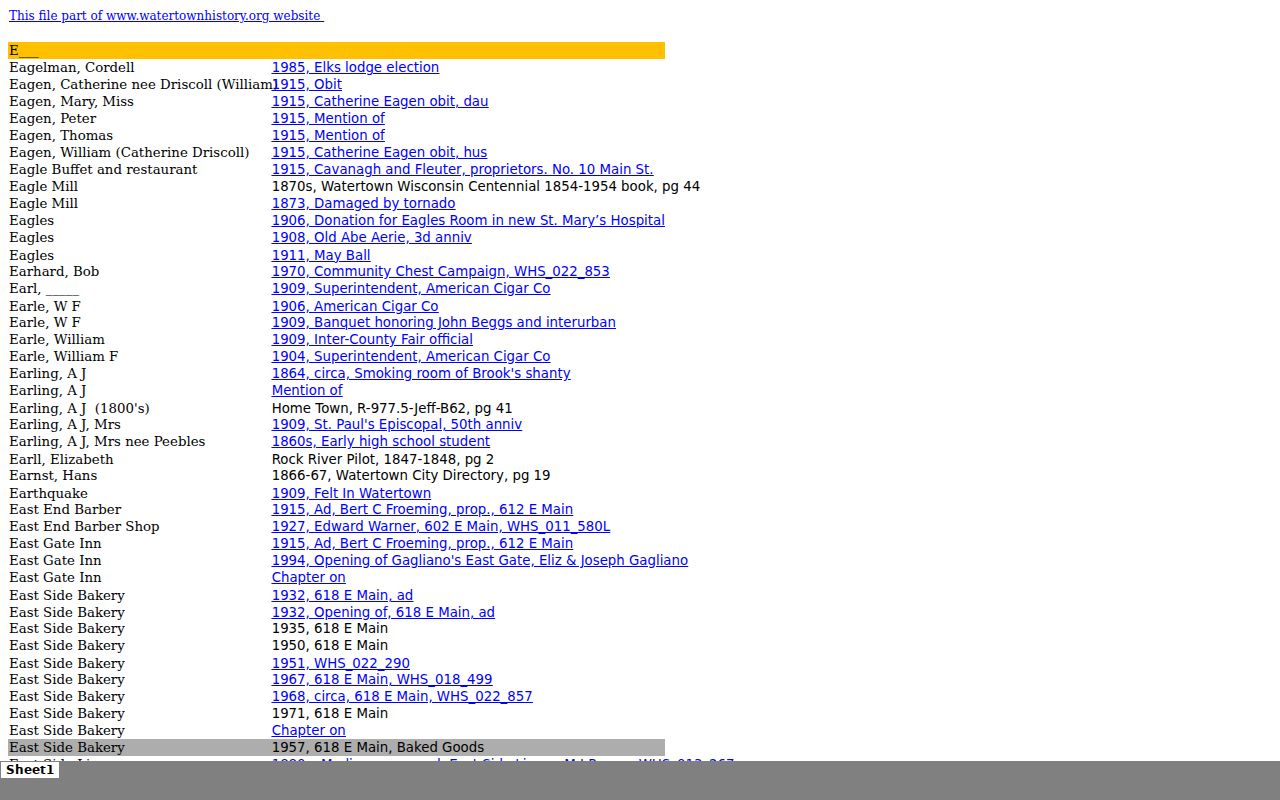
The screen is best used to locate a source. The printed directory entry remains the record that must be read and cited.
Publishers Behind Watertown City Directories
National Register research identifies Wright and Hogg of Milwaukee in the citation trail for the 1885 directory. A.G. Wright is named for the 1887, 1893, and 1899-1900 volumes. These publisher notes help distinguish editions that may format names and addresses in different ways.
| Year or period | Documented directory milestone |
|---|---|
| 1866-67 | Earliest specifically identified Watertown issue and indexed page references |
| 1885 | Wright and Hogg appears in the National Register citation trail |
| 1887, 1893, 1899-1900 | A.G. Wright is named in property-research citations |
| 1866-1900 | Twelve listed issues collected on the Historical Society CD-ROM |
A change in publisher may also change abbreviations, who received a separate listing, and whether businesses appear in the same sequence as residents. Record the title page, year, publisher, and page number with each transcription.
Decode a Watertown Directory Entry
A printed entry may hold several facts in a compressed line. Look for the surname and given name, spouse or widow notation, occupation, employer or business, street number, and any mark for boarding or ownership. The captured online index does not expose a full page or its abbreviation key, so these fields are a reading checklist, not a claim that every Watertown volume contains all of them.
| Indexed name | Start with the exact spelling, then test initials and variants |
|---|---|
| Source and page | Preserve the directory year and page supplied by the master index |
| Street address | Transcribe the printed number and street as shown, even if modern spelling differs |
| Work or business | Note the occupation and any employer or business address separately |
| Household notation | Copy spouse, widow, boarder, or ownership marks exactly before interpreting them |
Directory layouts change. Photograph or copy the key at the front of the volume when one exists. A business address may not be the person's home, and a widow notation can be a lead to a death notice rather than proof of when a death occurred.
- Criss-cross directory
- A later directory format arranged by street or phone number, useful when the address is known but the name is not.
- Householder index
- An address-ordered list of the principal person recorded for a dwelling, not a complete household census.
- Abbreviation key
- The publisher's legend for short forms and symbols. Its meaning can change between editions.
Watertown Library Research Channels
Watertown Public Library at 100 S Water Street is the main local research stop when an online index is not enough. Its online resources page lists HeritageQuest, Ancestry Library Edition for in-library use, Archive of Wisconsin Newspapers, NewsBank, and Newspapers.com Library Edition. The library can also clarify whether a needed directory, reverse directory, yearbook, local history, or obituary tool is on a shelf or microfilm.
The newspaper tools add the human context that a city directory often lacks. NewsBank names the Watertown Daily Times and Daily Jefferson County Union among its local and regional titles. An obituary, wedding notice, anniversary item, probate notice, or business announcement may explain why a name appears, moves, or vanishes between issues. Licensed access may require a library card or an in-library visit.
The library resource page shows the available database routes. Open the official library list before reviewing the image below.
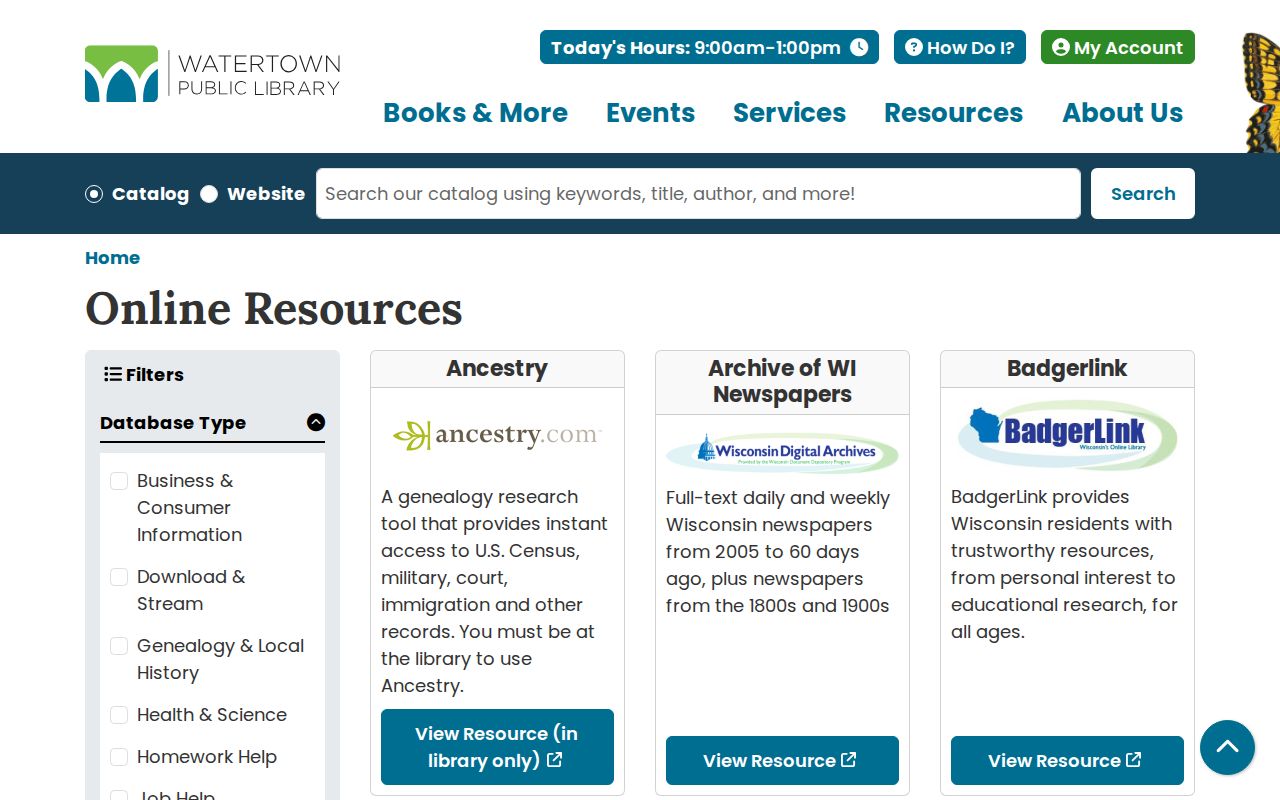
The page identifies the access point, while library staff can confirm the exact coverage and login rules for a particular search.
Note: Call 920-262-4090 to confirm a directory year or database access rule before making a special trip.
Trace Watertown Families Across Years
A city directory is a dated snapshot. A sound family-history trail compares several snapshots and records each source without smoothing over differences. Use the address as a steady key, but keep the two-county line, annexations, and old street forms in view.
- Begin with the nearest known surname or address in one listed directory issue. Record the spelling, printed address, occupation, page, and source year.
- Move to the next available issue. Note a new number, street, trade, spouse notation, or business address instead of assuming the same household.
- Pair the directory with the nearest public federal census. The census can show household members and relationships that the directory omits.
- Check the county parcel or deed record when title matters. A directory suggests occupancy, while a deed identifies an owner in a recorded transfer.
- Use newspapers, vital indexes, probate files, or cemetery records to explain the end of a directory trail.
A person can disappear because of death, a move, a spelling change, a missed issue, or a listing under someone else. Search the address, a spouse, initials, and the next available issue before deciding which explanation fits.
Watertown Directories Meet Property Files
Wisconsin Historical Society and National Register property records show how local researchers pair people with buildings. Watertown citations include the 1885 directory, Sanborn fire-insurance maps from 1884 and 1890, tax records from 1860 through 1910, later directory material, library holdings, and Octagon House resources. A Sanborn map shows building shape, use, and construction context, but it does not prove occupancy.
The City's historic property information page points to the Wisconsin Historical Society, local historical resources, and county Register of Deeds records. For a house inquiry, build a row for each date with the printed address, listed person, occupation, directory page, deed owner, and confidence level. If an old number fails, search the block, cross street, legal lot, and prior municipality.
Watertown Cemetery Directory Endpoints
Oak Hill Cemetery and St. Bernard's Cemetery can close or redirect a resident trail. Oak Hill Cemetery Association was founded in 1850, and its present grounds were purchased or used in the 1865 relocation. The association maintains interment-ledger history at 1540 E Main Street and can be reached at 920-261-6022. Online public search availability was not confirmed.
St. Bernard's Cemetery is just off Milford Street and County Road A. Its parish page links a searchable database and lists a cemetery coordinator at 920-342-0691. Burial evidence may supply dates, relatives, and plot location, but burial at Watertown does not prove the deceased lived at the cemetery address or remained in the city until death.
Use a cemetery entry to return to the newspaper and directory sequence. A death date can focus an obituary search, while a spouse or family name can reopen a city directory search under another surname.
Other records can extend the same Watertown trail. Wisconsin Historical Society's pre-1907 vital index is organized by county and date, and its result can point to a volume, page, reel, or sequence. Church registers may preserve a baptism, marriage, burial, or membership entry, but no complete official inventory of Watertown parish runs was found. Naturalization and military records may sit with county, state, or federal archives. Ask for a named record group instead of assuming that every local source was digitized.